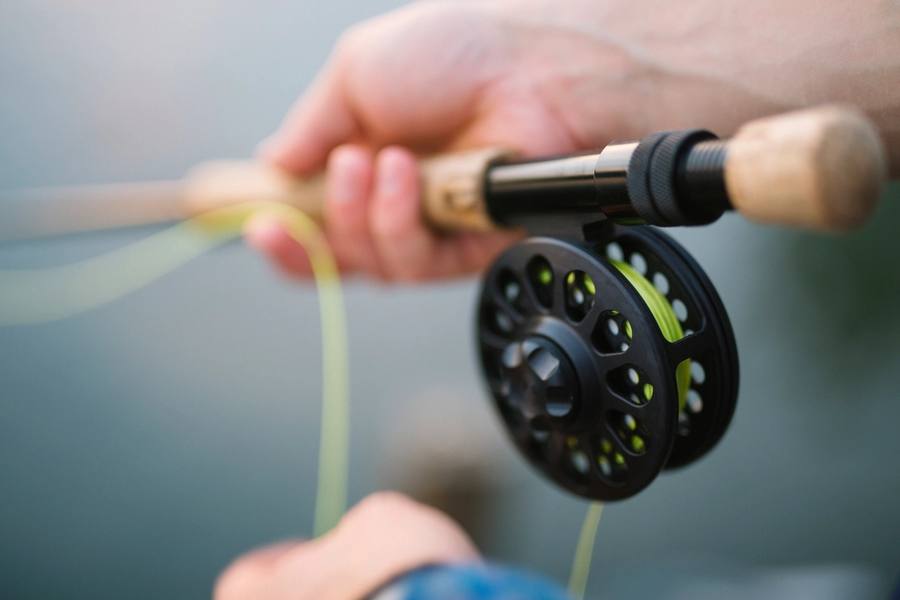
Symbolbild (Stockfoto); nicht das abgebildete Produkt.
Mostly A Line Holder, Until It Is Not
Most trout are landed by stripping line in by hand rather than on the reel, which is why the reel is frequently described as a line holder.
That stops being true the moment a fish takes enough line to reach the backing, at which point the drag becomes the only thing between you and a break.
For small stream fishing a simple reel is genuinely sufficient, and for larger fish or saltwater the drag matters as much as on any spinning reel.
Large Arbor And Why It Helps
A large arbor spool has a wider core, which means each turn of the handle retrieves considerably more line than a narrow traditional spool.
That matters when a fish runs toward you and slack must be recovered quickly, which is when fish are lost.
Line also comes off a large arbor with less coiling memory, which reduces the tangles that plague narrow spools in cold weather.
Sealed Drags And Where They Matter
Sealed disc drags keep grit and salt out of the drag surfaces, which is essential in saltwater and useful anywhere sandy.
Unsealed drags are cheaper and require cleaning and are perfectly adequate for freshwater trout fishing.
A sealed drag also cannot be serviced at home in most designs, which is a consideration over a long lifespan.
Balance With The Rod
A reel that is too light leaves a rod tip-heavy and tiring over a day of casting, which is a real fatigue issue rather than an aesthetic one.
A rod and reel that balance at roughly the point of the grip feel considerably lighter in use than the total weight suggests.
Chasing the lightest possible reel frequently produces a worse-feeling outfit, which is counterintuitive and consistently reported.
Backing, Capacity And Setup
Backing sits under the fly line and provides reserve when a fish runs beyond the line, and a reel must hold both.
Stated capacity assumes a particular backing diameter and overfilling a spool causes line to catch under the frame.
Having a shop load a reel correctly the first time is worth it, since winding a fly line on under even tension by hand is awkward.
Retrieve direction is changed on most fly reels by reversing the drag mechanism or flipping a clutch, which is a straightforward operation with instructions and an awkward one without. Left hand wind is conventional for right handed casters and preference varies genuinely. Setting it before the first trip rather than discovering it riverside is worth the five minutes.
Materials affect corrosion resistance considerably, and an anodised aluminium reel survives saltwater where a painted or plated one corrodes under the finish within a season.
Machined reels are cut from solid bar and cast reels are poured into a mould, with machined being stronger and lighter for the same size and costing considerably more.
Click and pawl drags are traditional and give a sound rather than real braking force, which suits small stream fishing and is inadequate for anything that runs hard.
The Verdict
A component that matters less than the rod and line for small fish and becomes critical for anything that runs.
Light reels leave rods tip-heavy, sealed drags cannot be home serviced, and overfilled spools catch line.
Balance it against the rod. The lightest reel frequently makes the worst-feeling outfit.
Auf einen Blick
Vorteile
- Large arbor recovers slack quickly
- Less line memory and fewer coils
- Sealed drags survive salt and grit
- Spare spools allow different lines
Nachteile
- Overspecified for small stream trout
- Sealed drags are not home serviceable
- Too light a reel unbalances a rod
- Overfilled spools catch under the frame
Häufig gestellte Fragen
Does the reel matter for trout?
Less than the rod and line, since most trout are landed by stripping in by hand. It matters entirely the moment a fish runs into the backing, when the drag is the only thing preventing a break.
What does large arbor do?
A wider core retrieves considerably more line per handle turn, which matters when a fish runs toward you and slack must be recovered fast. Line also comes off with less coiling memory, reducing cold-weather tangles.
Should I buy the lightest reel I can?
No. Too light a reel leaves the rod tip-heavy and tiring across a day. An outfit balancing around the grip point feels lighter in use than its total weight suggests, which is counterintuitive and consistently reported.
Spezifikationen
| Type | Large arbor fly reel |
| Usual role | Line holder for smaller trout |
| Critical when | A fish reaches the backing |
| Large arbor benefit | Fast slack recovery, less memory |
| Sealed drag | Salt and grit; not home serviceable |
| Balance | At roughly the grip point |
| Setup | Backing under the fly line |
| Avoid | Overfilling the spool |
Fazit
A line holder until a fish runs. Balance it to the rod rather than chasing the lowest weight.
Preis auf Amazon prüfen