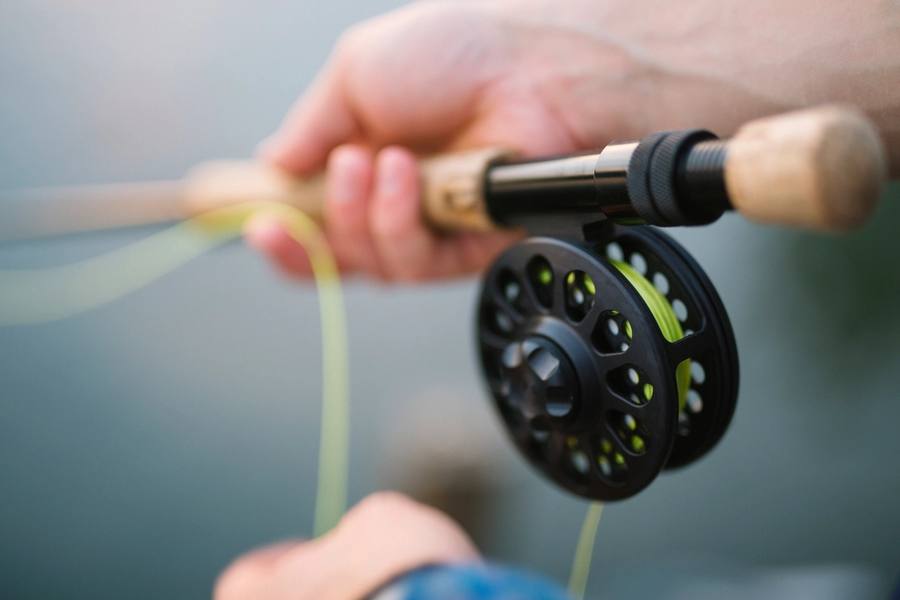
Image illustrative (photo de stock) ; ce n'est pas le produit exact.
It Does One Thing Extremely Well
A centrepin has no gearing and no bail arm, and the drum turns freely, which lets a float run downstream at exactly the speed of the current.
That drag-free presentation is what a float fishing angler is trying to achieve, and no fixed spool reel matches it.
For trotting a river for roach, chub, barbel or grayling it is genuinely the best tool available, which is why it survives despite being archaic.
It Is Poor At Everything Else
Casting a centrepin is difficult, requires specific techniques and never achieves the distance or ease of a fixed spool reel.
Retrieving is slow since there is no gearing, which means every turn of the handle brings in one drum circumference of line.
Anybody buying one as a general reel will find it frustrating, and it should be bought as a second reel for a specific job.
Casting Techniques
The Wallis cast and the Nottingham cast are the traditional methods, and both take real practice to perform without a tangle.
Side casting and simply pulling line off by hand and swinging a float out are simpler and cover shorter distances.
Most trotting is done at close to medium range with the float allowed to travel downstream, which reduces how much casting distance actually matters.
Drag, Or The Absence Of It
Most centrepins have no drag at all, and a running fish is controlled by fingers or a palm against the rim of the drum.
That is direct and tactile and requires attention, since a fast fish spins a drum rapidly and a careless finger gets hit by the handle.
Some have a light check or an adjustable ratchet, which prevents overrun rather than providing meaningful drag against a fish.
Bearings And Running Free
The quality of a centrepin is measured by how long and how freely the drum spins, which is entirely about bearing quality and balance.
A drum that runs for a long time on a spin is sensitive to the pull of a float in slow current, which is where the presentation advantage comes from.
Grit and oil-thickening slow a drum noticeably, and these reels need cleaning and light oiling more often than their simplicity suggests.
Drum diameter and width affect both line capacity and how much line comes in per turn, with wider drums holding more and narrower ones being easier to control with a finger. Traditional designs tend toward larger diameters for exactly that retrieve advantage. Weight matters as well, since a heavy centrepin on a long float rod is tiring across a day of holding the rod rather than resting it.
Line guards prevent line falling behind the drum and jamming between the drum and the frame, which is the characteristic tangle of these reels and is genuinely awkward to clear.
Ratchet settings on reels that have them are for preventing overrun when pulling line off rather than for playing fish, and leaving one engaged during a run does very little.
The Verdict
An unmatched tool for trotting rivers and a poor choice for anything else, which makes it a deliberate second reel.
Casting is difficult, retrieve is slow, and most have no drag against a running fish.
Buy it for trotting, not as a general reel. It does one job better than anything and everything else worse.
En un coup d'œil
Avantages
- Unmatched drag-free float presentation
- Direct tactile contact with a fish
- Simple with almost nothing to break
- Free-running drums are highly sensitive
Inconvénients
- Difficult to cast any distance
- Very slow retrieve with no gearing
- Usually no drag at all
- Drums slow with grit and thickened oil
Questions fréquemment posées
What is it actually for?
Trotting a float downstream at exactly the speed of the current, with no drag from the reel. That presentation is what float anglers are trying to achieve and no fixed spool reel matches it.
Can I use it as a general reel?
You will find it frustrating. Casting is difficult and limited, and with no gearing the retrieve is very slow. Buy it as a deliberate second reel for river float fishing rather than as an upgrade.
How do I play a fish with no drag?
With fingers or a palm against the rim of the drum, which is direct and tactile and demands attention. A fast fish spins the drum rapidly and a careless finger gets hit by the handle.
Spécifications
| Type | Centrepin trotting reel |
| Excels at | Drag-free float presentation downstream |
| Poor at | Casting and retrieving |
| Traditional casts | Wallis and Nottingham |
| Drag | Usually none; fingers on the rim |
| Quality measure | How freely the drum spins |
| Maintenance | Clean and light oil regularly |
| Best use | A deliberate second reel |
Résumé
Best in the world at one job and poor at everything else. Buy it knowing exactly that.
Vérifier le prix sur Amazon