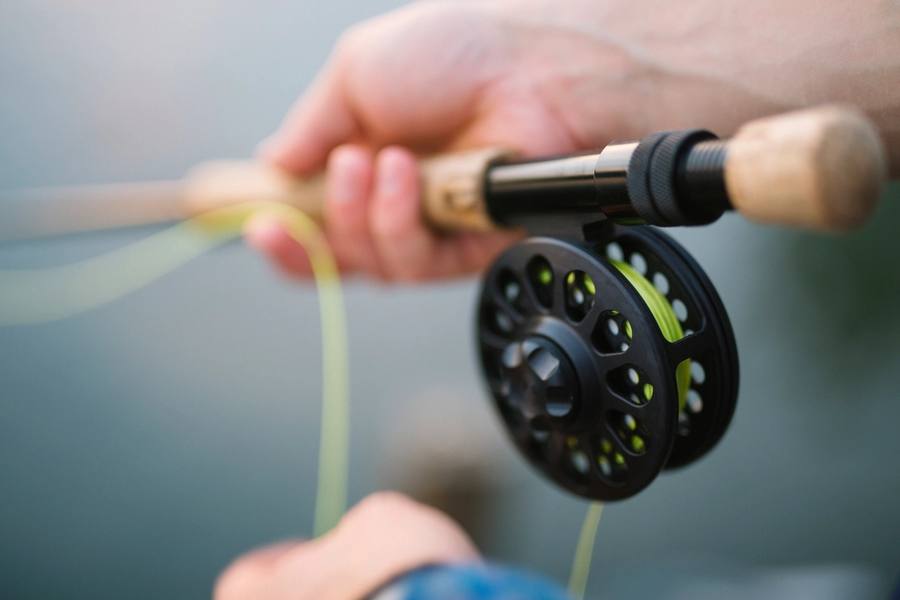
Temsili görsel (stok fotoğraf); ürünün kendisi değildir.
Badly Loaded Line Ruins A Session
Line wound onto a reel without tension sits loosely, which means under load the outer wraps cut into the loose wraps beneath and jam.
Line wound with twist coils off the spool in loops, tangles in the guides and reduces casting distance substantially.
Both problems are created at the moment of loading rather than during fishing, which makes spooling correctly a job worth doing properly once.
Spool Direction Is The Common Error
Line comes off a filler spool in a particular direction, and it must go onto a fixed spool reel in the same rotational direction or twist is introduced with every wrap.
Laying the filler spool label up or label down determines this, and the standard check is to wind a few turns and see whether the line twists or lies flat.
That check takes ten seconds and prevents a problem that otherwise persists for the life of the spool of line.
Tension Is What Prevents Digging In
Line must go on under firm steady tension, which packs it tightly and prevents the outer wraps bedding into the inner ones under load.
Running the line between a gloved finger and thumb achieves this by hand, and a spooling station does it consistently and without burning fingers on braid.
Braid in particular needs high tension and is notorious for digging in when loaded loosely, which locks a spool solid on a hard take.
Backing Under Braid
Braid is slippery and spins on a bare spool rather than gripping, which means the whole spool of line rotates instead of the fish pulling against the drag.
A short length of monofilament backing, or a strip of tape across the spool arbor, gives the braid something to grip.
Skipping this step produces a reel where the drag appears to have failed, which is a confusing fault with a simple cause.
How Much Line And Where To Stop
A spool should be filled to within a couple of millimetres of the lip, since underfilling loses casting distance and overfilling causes line to spill off in loops.
That level is easy to judge visually and hard to correct afterwards without stripping line off.
Filling a deep spool entirely with expensive braid is wasteful when a backing of cheap monofilament takes up most of the volume.
Line memory and age matter more than people allow, since monofilament degrades in ultraviolet light and stiffens over a season on a spool left in a car or a shed. Line that comes off in tight coils has usually been stored badly rather than being inherently poor. Replacing main line annually is a small cost against the fish lost to line that has quietly gone brittle.
Braid does not degrade in sunlight the way monofilament does and lasts several seasons, which offsets a considerable part of its higher initial cost.
The Verdict
A simple accessory that prevents the twist and tangle problems created at loading rather than on the water.
Wrong spool direction introduces permanent twist, loose loading digs in, and braid spins without backing.
Check the spool direction before winding. Twist introduced at loading stays for the life of the line.
Bir bakışta
Artılar
- Consistent tension prevents digging in
- Avoids burning fingers loading braid
- Makes spool direction easy to control
- Cheap against wasted line and lost fish
Eksiler
- Another item to store
- Cheap clamps slip under real tension
- Not needed if you have a second person
- Does not prevent overfilling on its own
Sıkça sorulan sorular
Why does my line twist?
It was loaded in the wrong rotational direction relative to the filler spool. Wind a few turns and look — if it twists rather than lying flat, flip the filler spool over. The check takes ten seconds and the fault otherwise lasts the life of the line.
Why does my braid spin on the spool?
Braid is slippery and does not grip a bare spool, so the whole spool rotates instead of the drag working. A short mono backing or tape across the arbor fixes it, and skipping it looks exactly like a failed drag.
How full should the spool be?
Within a couple of millimetres of the lip. Underfilling loses casting distance; overfilling makes line spill off in loops. It is easy to judge by eye and awkward to correct afterwards.
Teknik Özellikler
| Type | Line spooling and tension station |
| Prevents | Line twist and digging in |
| Critical check | Filler spool rotation direction |
| Test | Wind a few turns, look for twist |
| Tension | Firm and steady throughout |
| Braid needs | Mono backing or tape on the arbor |
| Fill level | Within a couple of mm of the lip |
| Economy | Cheap mono backing under braid |
Özet
Twist and tangles are created at loading. Check the direction, load under tension, back the braid.
Amazon'da Fiyatı Kontrol Et